Showing posts with label africa. Show all posts

Wednesday, December 2, 2009

Anubis - Guardian of the Dead

\

Anubis is the Egyptian god of the dead, Mummification, Embalming, Magic and the Guardian and Guide of Lost Souls and Orphans. In addition, Anubis weighed and judged the hearts of the dead. He is also the Egyptian version of the personification of time. Anubis is depicted most commonly as a human form with a black Jackal head or just as a black Jackal.


Anubis is one of Ancient Egypt's oldest gods, but when Osiris was introduce Anubis was 'demoted' and turned into one of the sons of Osiris. Anubis is also the son of Nephthys, the wife of Set. Unlike his Step-Father/Uncle, Anubis shows compassion and dislike of cause havoc for civilization. He was quickly abandoned by both his mother and step-father. Osiris' wife Isis found him and raised him as her own and Anubis later became her guardian and helper.

Anubis was a guardian in more ways than one. As a guardian of Lost Souls and Orphans, he not only protected them from harm but guided them. Anubis protected the innocent from Ammut during the judging of the heart. He also protected his adoptive mother Isis from Set as she went about her journey to reclaim all the pieces of Osiris' body and bring him back to life.

Citations:
"The Gods of Ancient Egypt -- Anubis." Egypt Travel, Tours, Vacations, Ancient Egypt from Tour Egypt. Web. 03 Dec. 2009. .

Images:

Thursday, November 19, 2009

Animals in African Folk Art

Crocodile made of recycled bug spray can, South Africa.
Folk art in its broadest sense means art derived from a people, or folk, as distinguished from the products of professional artists. A brief description of folk art is that it comes from groups of people who live within the general framework of a developed society but who are, for reasons of geographical or cultural isolation, largely cut off from the more advanced artistic productions of their time. It is the art of peasants, shepherds, sailors fisherfolks, artisans, and small trades people who live away from cultural urban centers in nations that are not heavily industrialized. Folk art is art that is produced by people who are not formally educated in art. They generally use materials that are common in everyday life. Folk artists create for the sake of creating something. In Africa, there are many folk artists. African folk art is usually created with household objects, metal objects, toys, textiles, masks, wood sculpture and more. The images that I have here are images of small sculptures that were made in South Africa of recycled products.

Cow made of recycled plastic bottle tops and can, South Africa

Most of the African folk art I have seen is bright, vibrant and full of life. Their art is reflecting their life. Most artists commonly use Coca Cola products too because of the life support they have provided for people in African countries. It is the art of expression and they make little products that they desire or want to have. It is kind of the spirit of wishful thinking.


Information from:

http://www.artincontext.com/artist/ringgold


Images are from:

http://goafrica.about.com

Monday, November 2, 2009

Body Adornments of the Surma


The Surma are a pastoral people from Ethiopia. They have several forms of body adornment that they practice. These adornments range from gauging the ears to exceptionally detailed face and body painting. One of the more extreme forms of body adornment practiced by the Surmas is body scarification which is a process by which tiny cuts are used to etch designs and patterns into the skin and as the cuts begin to scar the designs become a permanent feature of the skin Another unusual adornment custom is lip plates or lip plugs that are done mainly by the women of the Surmas. Women insert large clay plates into their bottom lips. The larger the plate the more desirable the woman and the higher her dowry is.

An example of scarification.

A young Surma woman with a lip plate and gauged earlobes.

Citations:
"Body Art: A Means for Self Expression." African Conservancy. Web. 2 Nov. 2009. .
Os, Joseph V. "Vanishing Cultures of Ethiopia's Omo Valley." Joseph Van Os Photo Safaris. Web. 2 Nov. 2009. .

Images:

Sunday, October 25, 2009

Canopic Jars of Ancient Eygpt


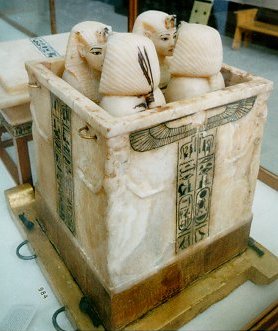
These elegant jars can have an unsettling effect on some people because of what they were used for. Canopic Jars are used to hold the stomach, liver, lungs, and the intestines of embalmed person. Each internal part was protected by a different goddess while each jar was topped with a god's head that represented a cardinal direction. The god Hapi (the baboon), who represents the north, is accompanied by the goddess Nephthys in protecting the lungs. The South is represented by the god Imseti (human-headed) whose companion is the goddess Isis and they protect the liver. The god Duamutef (the Jackal), represents the east, is accompanied by the goddess Neith in the responsiblity of protecting the stomach. Last but not least is the god Qebehsenuef (falcon), represents the west, and his companion the goddess Selket that protect the intestines.
A weathered set of Canopic Jars.

Each jar lid is intricately carved and sometimes painted or trimmed in gold. Most are adorned with hieroglyphics. Canopic jars were normally made of calcite(also known as Egyptian Alabaster), limestone, or clay. However, calcite is the most prized material used. Canopic jars or vases are another example of the rule "form follows function". Canopic jars are normally stored in Canopic Chest that are just as artistically carved and inscribed.

King Tut's canopic jar set in its canopic chest.

Images:

Friday, October 9, 2009

Nkisi Nkondi


Discord is the tension caused by a lack of agreement among persons, groups, or things. When I first looked at a Nkisi nkondi (hunter figure) of the Kongo in Africa, I immediately felt tension. My first thought was that some person must really dislike another. After reading, I found that this was a half truth. The figures or "hunters" are wooden statues with nails, glass and other sharp objects driven into the body. It turns out that hunters are used with the help of a priest to punish wrongdoers in the African Kongo. A person will go to a priest and ask them to unleash the power of the nkisi nkondi. the person will swear an oath and drive a sharp object into the statue binding themselves to the spiritual forces within. Nails are usually not driven into the face or cavity of the stomach where magical ingredients are stored to attract spirits. The spirits of the hunter will track down the wrongdoer and bring justice upon them. The number of protruding objects and open holes show how often a particular hunter has been used. The result is a physical manifestation of tension between people in a culture. The harsh metals and glass clashing with the smoothly sculpted wood cause physical dicord in the viewer.