Monday, October 3, 2016

Related image   This piece created by Chen Hongshou, a Chinese artist of the 16th century.

Initial reactions: Known as Magnolia and Erect Rock, created in the Ming Dynasty. This piece is lightly colored, subtle. The lines are faint around the actual main flower and leaf, while the stem is a bit more defined. It is a lovely piece of artwork, with a type of watercolor tone and the way the flower stems from nowhere (from the corner rather than from the direct bottom) is similar to many other pieces we have seen, including the bamboo.

Research: This piece is kept in the Palace Museum in Beijing, and was created in his life time between the years of 1598-1652 AD. I could find almost no backstory to the lovely painting other than the artist's background. The piece is described thought o be washed painting.


I logged on with the wrong email: Cheyenne Wilson

Throne of King Nsa'ngu

INITIAL REACTION: There are many colors in this piece that play very well together. The blue accentuates the red very nicely. The hints of white give nice details to the piece. The lines in the piece allow the viewer to know what piece of the sculpture belong to which subject. There are multiple subjects of this sculpture, but the ones at the top seem most important as they are the biggest.

RESEARCH REACTION: While looking through the book I discovered that this sculpture was made by a Cameroon artist. The two figures in the back are twins, the court guardians. They are both fertility symbols as well. There is a male (on the left) and a female (on the right); the male holds a drinking horn, and the female hold an offering bowl. Njoya's footrest is made to look like armed guards which stand over images of councilors, which symbolizes wisdom. The serpents on the seat symbolize his strength in battles. Thrones like this were kept inside the palace and moved by throne bearers when the king held audiences in front of the palace.

REFERENCES:
O'Riley, Michael Kampen. "The Pacific." In Art Beyond the West, 260-261. 2nd ed. Upper Saddle River, NJ: Pearson Prentice Hall, 2006.
FIGURE 1:
http://www.studyblue.com/notes/note/n/african-art-final/deck/9427029
      This is a reproduction of the Greta Goddess of Teotihuacan, in Mexico City's National Museum of Anthropology. This photograph of the mural, taken by Thomas Aleto from Riverside, PA shows one section of the reproduction.

     The lines in this piece are mostly rounded, and the colors are all very bright and not blended. There seem to be several layers to the painting, as if it is telling a story rather than just depicting a scene. It looks like there is a lot of nature in the mural; the tree, the animals, and the dress of the figures in the foreground.

     The figures in the paintings represent deities. The Great Goddess can by identified by the feathered headdress and the pendant in her nose, which she is seen with in Tepantitla and Tetitla murals as well. The Great Goddess was initial interpreted as a male deity. It was until1974 that Peter Furst inspired other researchers to believe that this was a goddess instead.


Kongo Rikishi


Initial Reaction
     This figure seems to be large and menacing, holding a hand out as if too ward off something. The figure is in a contrapposto position. The hips are tilted and seem to jut forward, bringing the center of balance to mainly the (viewers) left foot with the manubrium directly above that food. There are two main diagonals that cut across in this piece. The first is the drapery and the legs that move from the bottom right to the upper left. The second is the angle of the torso and the club, moving from the upper right to the lower left.
After Research
     Kongo Rikishi was made by Unkei for the Grand South doors of the Todai-ji temple in Nara. This sculpture was made in 1203 using multiple sections of wood. This allowed for Unkei to have the freedom to make more dramatic movements within the piece, as it was 26'6". This guardian was paired up with another to help guard the temple. They are manifestations of a wrathful god in the Mahayana Buddhist pantheon.

              Wiki Commons

Wednesday, November 4, 2015

Bill Reid, Killer Whale, Description


Bill Reid, Killer Whale


Bill Reid’s Killer Whale is a beautiful mixture of curved, flowing lines and hard edges.  The large, cylindrical head blends in to the crescent form of the body.  The crescent form can also be seen in the fins and tail, repeating a number of times throughout the work.  A hard-edged, flowing U shape outlines the mouth.  Inside, the teeth are represented as a series of interlocking, repeating triangle shapes.  The repeating circular shapes enhance the large spherical eyes.  The smooth and polished body is inlayed with circular and organic shapes.

The contrast between the soft flowing curves and hard edges create a very striking piece.  The repeating forms and shapes strengthen the sculpture by creating balance throughout.  The flowing crescent shapes create a sense of movement and guide the viewer’s eye through the entire piece.  As the tail delicately rests on the base, the space surrounding the sculpture gives it a sense of weightlessness.


Photo Credit: Travis S.


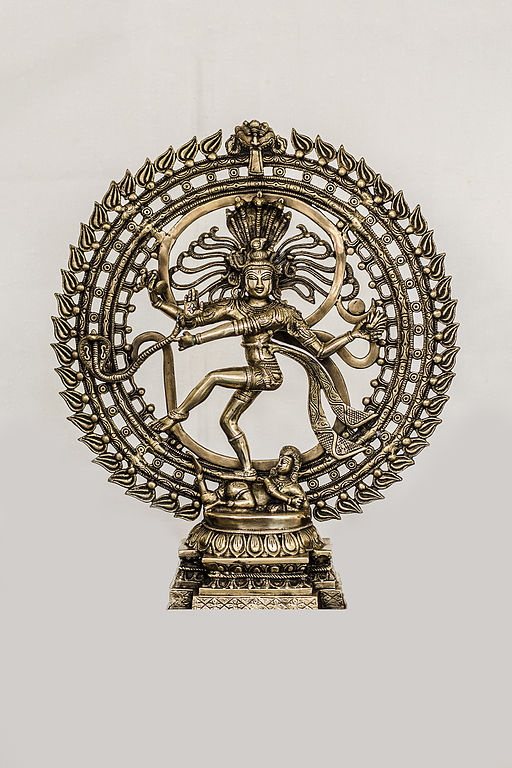
Shiva as Nataraja Description


This is a sculpture of Shiva, made in India during the Chola period, 11-12th century. It is made from bronze and is 32" in height. The lines used in this piece are almost all rounded and formed around the figure. There are many square-like patterns used around the ring of the sculpture and also in the jewelry around Shiva's neck and in the base. The value in the piece shows Shiva as slightly lighter bronze than the rest of the sculpture, presumably so that she stands out more. The figure itself is posed with arms out to the sides, holding up the ring around it, and its other arms are facing outward towards the viewer. Its leg is also held outward while the other leg stands atop a demon-like figure. The sculpture has a surprising amount of negative space around the main focus of the piece. The texture looks very smooth in the figures and the base, but the head piece and the ring around the sculpture looks very sharp or even menacing in some way. The flames around the ring gives the piece a sense of power and ferocity.

The balance and movement of this piece were perfected very nicely. The piece, although more left side oriented, still remains balanced due to the ring and the figure along the bottom. There is a large sense of unity in this piece and everything works very well together, even though the flames are not used anywhere else in the piece. They still serve a visually pleasing purpose. The proportions show that Shiva is the main focus, rather than the demon she is standing on and the ring, although larger than Shiva, still keeps the attention held on her. There is a lot of emphasis on Gods standing on demons to show their power and I think the piece really demonstrates power and strength as well as protection.

Image Attribution: Augustus Binu
File:Bharat Mata.jpg  


Bharat Mata Description                   

 This painting demonstrates a highly simplistic style, utilizing large amounts of empty space around the figure as well as the muted color palate. The primary colors throughout this piece range from warm oranges down to soft greens. This use of color allows for a blended value within the painting.Cylinders and circles create the basic shape of the woman and again lends a softness to the piece.The lines that are used in this painting are extremely clean and precise, the woman and the objects are clearly outlined. 

There is a sense of balance and unity created by this painting. The woman's arms are positioned in a very natural and proportionate way, giving her a realistic appearance. The lightening of color and the highlight of blue behind her head emphasizes the woman's face as the focal point. The graceful way the woman is standing gives the piece a sense of movement, the eye naturally flows from her face down to her feet.