Wednesday, November 7, 2018

Related image

Fisherman Description

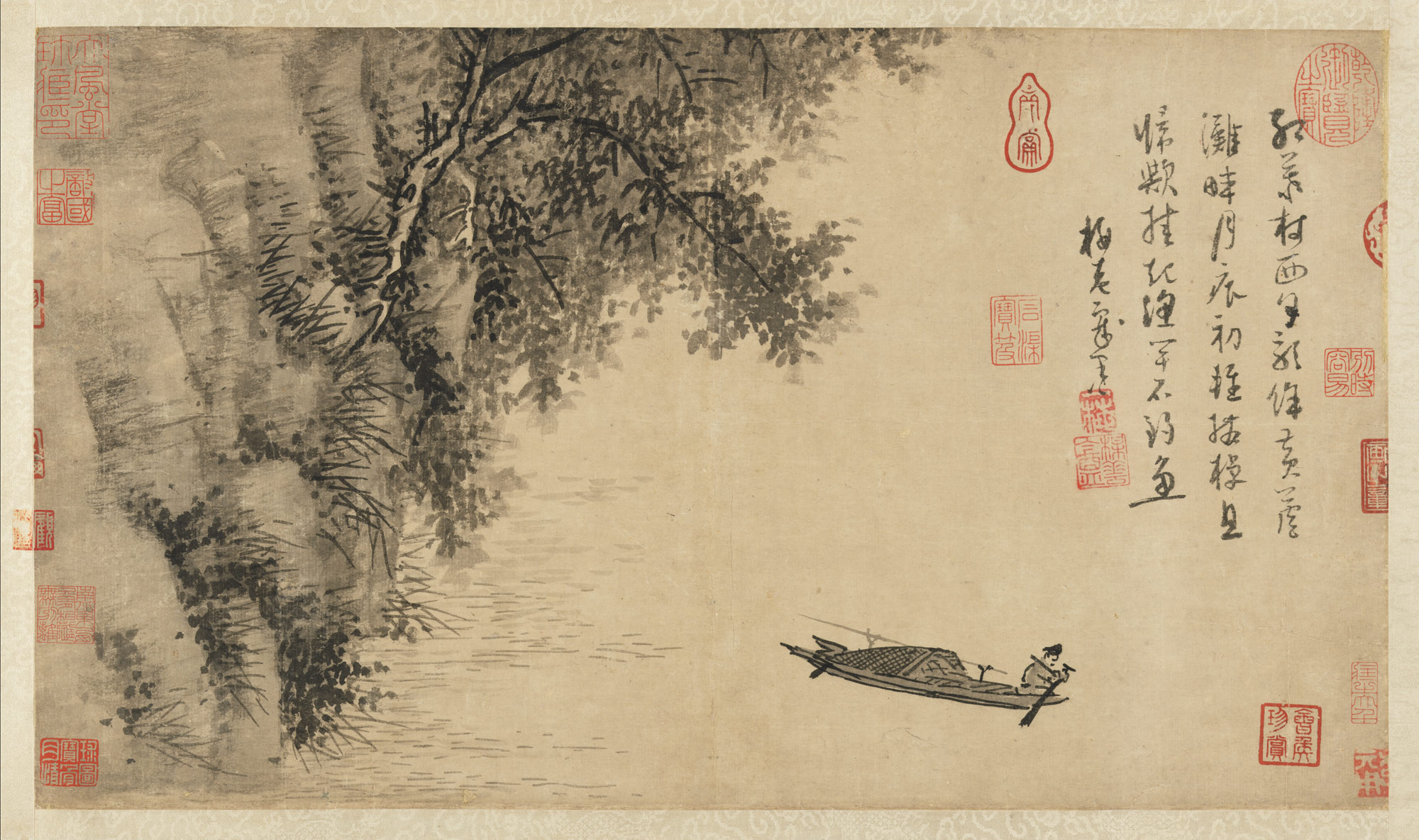
Fisherman made by the artist Wu Zhen (Chinese, 1280-1354) has remarkable elements. The line work on the leaves are curved along with the line work used on the branches on the tree to make the tree it self more lively. The artist uses a simple color pallet by only using ink on paper. Zhen gives the boat more vertical line structure for the boat while using curved line work on the fisherman on the boat. The value of the color of the art piece is manly dark with the lightness of the paper. This piece has an increasing amount of space.

The color of this piece only uses of black ink. The texture of the artist used on used on the mountain side gives a more realistic affect by adding the the vegetation growing on the side of the mountain. The why the artist painted the sea gives the since that the sea is at a stand still. The artist painted where there is very little movement going on. The tree limbs pointing down and very little movement of the boat and the sea would emphasize ow there is very little movement going on. The meaning of the righting on the right hand side is how the fisherman is ready to go back home after a long day of fishing. The stamps show how many individuals have owned this art work in the past.  

Source: https://www.metmuseum.org/toah/works-of-art/1989.363.33/

Portuguese Merchants and Trading Vessels

Image result for portuguese merchants and trading vessels

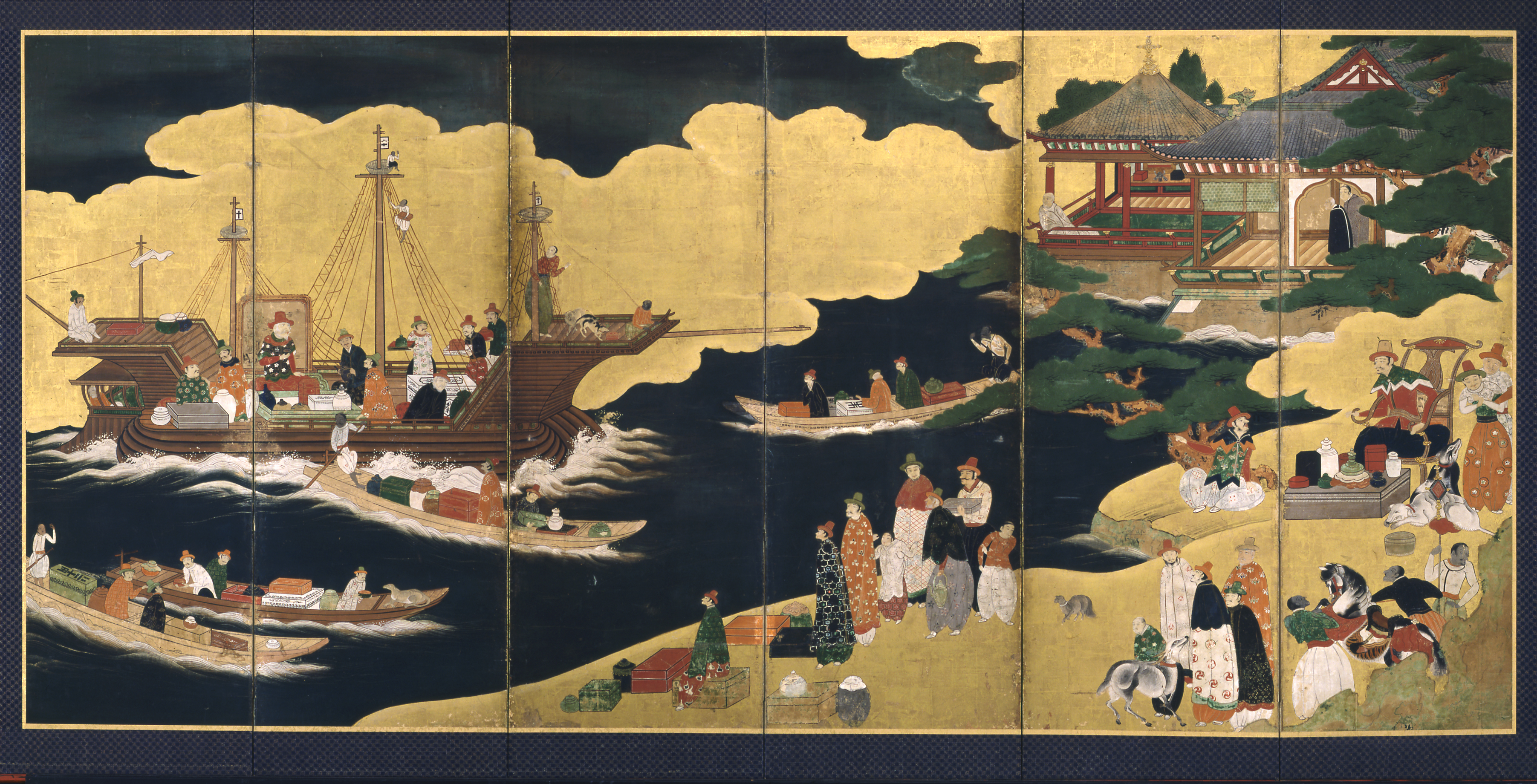
Portuguese Merchants and Trading Vessels is an early 17th century Japanese paper screen. The paper screen shows traders from the south, also known as namban byobu or southern barbarians. The piece shows the traders dressed in rather outlandish and gaudy hats and clothes compared to the other individuals seen in the piece. It is rather difficult to find the main character, assuming the subject is not the traders ship. The usage of color and shape is very pleasing, as it allows for a distinction between all of the defining areas of the image such as the land, sea, and clouds.

The most defining feature of this image is the superior usage of space between all of the components. This allows for each individual featured to be clearly different from the others around them. Along with this, the usage individual usage of color on each individual adds to the contrast of the image making for better personalization between the characters. With all of these components coming together as one, the unity and balance of this image makes it stand out among the other paper screens that would have been created along with it.

Paradise Under the Sea Description


Shigeru Aoki is a Japanese painter known mostly for combining Japanese legends and religious subjects in the late 19th century, early 20th century. This painting, Paradise Under the Sea 1907, is a telling of a Japanese legend of Prince Fire-fade who fell in love with the God of the Sea's daughter. The painting is in a tall, narrow frame and there is a woman on either side of the piece being split by a vase and a tree causing the piece to feel balanced and give it a sense of unity.  The colors tend to be muted and dark with the light blue of the dress on the right being one of the brightest things in the painting which guides the viewers eye to it and then up into the bright yellow light above the prince's head on a vertical path upwards. Everything seems to have a dark blue tint as if everything is underwater. The tree is cut off at the top into a round shape so the leaves stop suddenly to show a warm orange color. These colors stand out because it has no blue tint over it like the rest of the piece including the warmer colors such as the deeper reds to on the woman's dress and the bottom of the tree. There is not a lot of empty space in the piece with it being so long and narrow, the space seems full. 
Shigeru used a diving suit and a helmet to make sketches of light and color under water which reflect in the way the light diffuses on the women's wet, translucent dresses as well as the shadowy skin of the prince. He keeps true to his Japanese roots by keeping with his legends and myths but he shows his fascination with western art with the feathery brush strokes being fully visible, especially on the red dress. The composition of the piece as well as the theme are a reflection of his interest in English painters but the brushstrokes and nature sketches are a French Impressionist thing to do. He showed his interest in the western forms of art while also staying true to his Japanese heritage with his legends and ideals. 


Stone of Five Suns

Stone of Five Suns
File:Aztec Sun stone depicting their concept of the universe.JPG

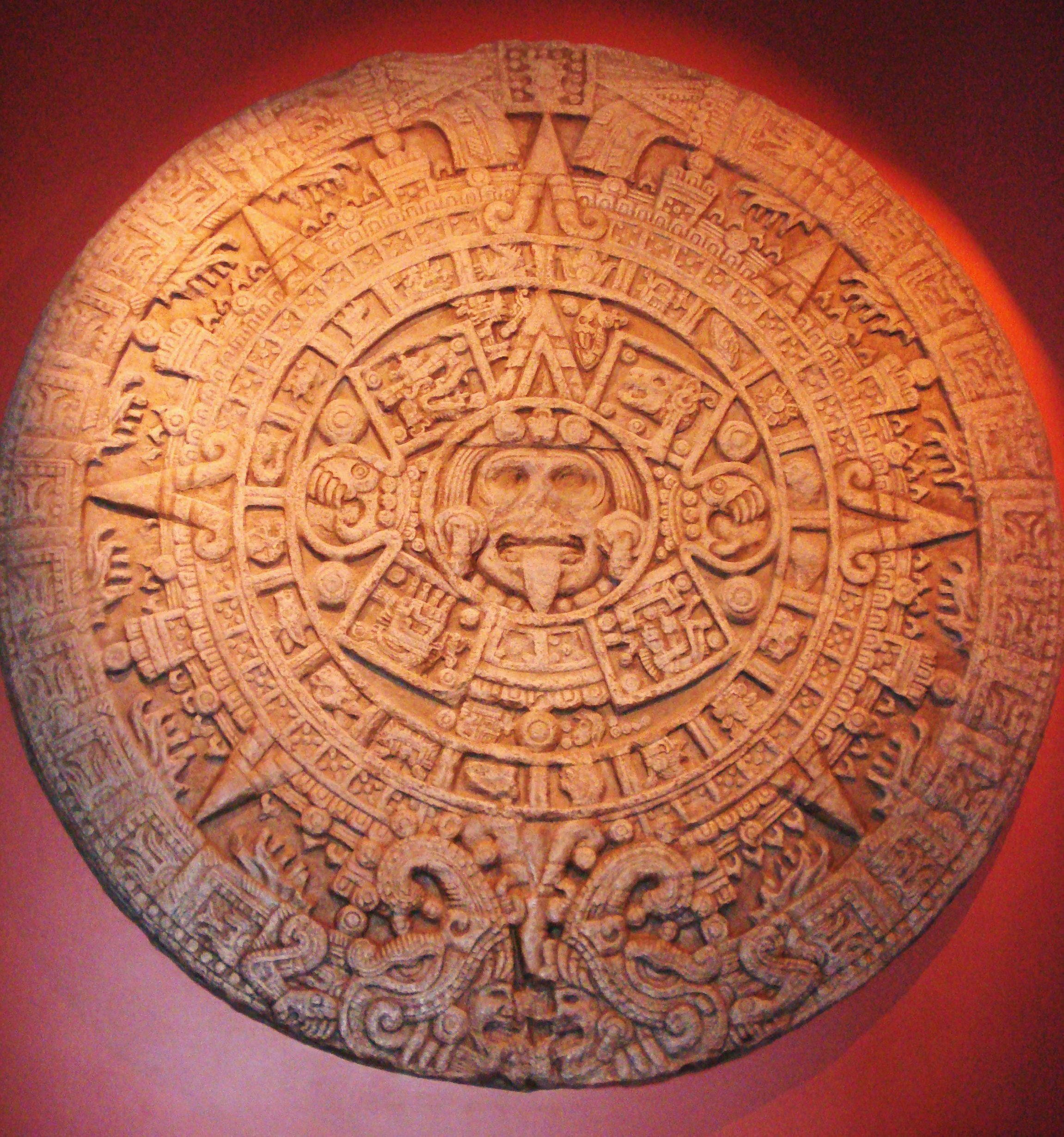
In this piece, it looks as it was carved from stone. The overall piece kind of looks as if it could be used as compass. The face in the center looks as if it could represent something important. The carvings of the piece are extremely detailed. It's like each carving in the piece has some sort of meaning behind it.

This piece was created at Teotihuacan. The story behind this piece involves two gods sacrificing their bodies to create new material for the world. One god arose to the Pyramid of the Sun, while the other God arose to the Pyramid of the moon. Then they both went in  bonfire. In the end they both became the sun and the moon. To repay the Gods, humankind had to provide human sacrifices in order to keep the fifth sun. Not only is this piece called the Stone of Five Suns. It's also called the Aztec Calendar Stone. The piece is made from stone, hence it is in the name of the work. There is really no actual author named for this piece, but it was created by the Azetcs.

Tuesday, November 6, 2018

The Two Fridas Description


The Two Fridas by Frida Kahlo (1939)
In one of her most popular and well-known works, Frida Kahlo's 1939 painting, The Two Fridas, was created as a  result of the emotionally and physically painful aftermath of her and Diego Rivera's bitter and messy divorce.

The double self-portrait carries heavy symbolism that references not only Rivera, but other aspects of Kahlo's life as well. As a duel-heritage citizen, prior to their marriage, Khalo dressed in European attire, however due to Rivera's passionate nationalism, Kahlo dressed in more traditional Mexican clothing to appeal to her husband's liking better. The two styles are portrayed as the 'two Fridas.' She had always felt that the Frida on the right was the one that Rivera loved, hence the picture of him in the locket in that figure's hand. The heart of the figure is also whole while the figure on the left is damaged and 'broken' because of Rivera's love for that version and the connection between his love versus the disconnection between his love and the version on the left. The scissors in the hand of the left Frida also symbolize the severing of the ties between her and Rivera.

Kahlo and Rivera's relationship are not the only represented in the massive oil painting however. The blood on the white dress is a reference to her fertility. 17 years prior to her creation of The Two Fridas, she was in a bus accident that left her with severe injuries. Over the years, Kahlo underwent many surgeries and suffered chronic pain. The injuries are also believed to have been the cause of several miscarriages throughout Kahlo's life, symbolized by the blood's location in the painting.

Overall, the composition generates a rather sad and tragic scene in which Kahlo was forced to endure every day for the rest of her life.


Gateway of the Sun Description

Picture by Mhwater
     This gateway in Taihuanaco, Bolivia depicts a smoothly carved stone gateway with low and high relief carvings at the top of the arch. Upon closer inspection one will see that the main figure in the middle is larger then the others and also appears to have a more ornate headdress than the other figures. The size difference in the figures most likely is meant to show that the larger figure is a one of power and might even be a depiction of a god. The smaller figures are depicted as having their own ornate headdresses and what may be tails or cloaks, this may point to the gateway being part of an old temple where ceremonies were held. The fact that the bottom part of the gateway is smooth may have to do with the wear of time or it may have been kept smooth on purpose in order to draw more attention to the carvings at the top of the arch.

     The large figure at the top is a depiction of the sun-god and may actually be the God Viracocha, whom was said to have created all things, but researchers lack enough evidence to prove this. The figure is one of ceremony as it is holding ceremonial staffs with feline and condor heads on either end of the them. The smaller figures are meant to be his close servants and it is unclear if they are human or not. Due to lack of evidence surrounding this gateway there have been many theories about what its' meaning is and why is was built. Some historians believe it to have been built as a gateway to another realm while others theorize that it was made to be a calendar.

Citations:
Smithfield, Brad. "The Gate of the Sun: A megalithic solid stone structure, confusing experts ever since its discovery." 19 April 2017. The Vintage News. 1 November 2018. <https://www.thevintagenews.com/2017/04/19/the-gate-of-the-sun-a-megalithic-solid-stone-structure-confusing-experts-ever-since-its-discovery/>.    

O'Riley, Michael Kampen. "Western Polynesia: Tonga and Samoa." O'Riley, Michael Kampen. Art Beyond the West. Ashville: Pearson Prentice Hall, n.d. 278.

Raimondi Stela Description

Raimondi Stela, Chavin de Huantar c. 460-300 BCE
This is a drawing of the Raimondi Stela that was originally drawn by Antonio Raimondi. This drawing depicts the Staff God of the Chavin de Huantar (900-200 BCE) as shown through the figure holding the two ornate staffs. There is a lot of line work and ninety degree intersections. most of the lines are fairly straight with occasional curvature that serves to create more detail for the figure. The god is shown with four heads with three stacked on top of the central head about one-third of the way up from the bottom. Their is sharp and precise symmetry between the left and right sides of the image and this balance of symmetry was a key component in Chavin art.

This piece shows several of the characteristics of Chavin art including the perpendicular intersections, simple lines repeated upon themselves to create a complex image, and symmetry. The piece also shows the technique of Chavin artists of using other animalistic ideas for body parts. The god is depicted with other heads for hair and with the heads sprouting serpentine appendages. This image creates a sort of illusion with the heads that was part of Chavin ceremonies that would be conducted with hallucinogenic snuffs. As a piece in total, it depicts the Chavin connection to abstraction and complexity.

Resources:
Fig. 1. Raimondi Stela, The Staff God. 2012, drawing, 6'5"*2'5". Wikimedia Commons,https://commons.wikimedia.org/wiki/File:Raimondi_Stela_(Chavin_de_Huantar).svg
(accessed November 6, 2018).