Monday, October 8, 2018

The Red Fudo


Before Research:

The tone of the image is what first draws the viewer in. Fudo is looking very intense and lost in thought, while his disciples are almost playful with the imagery that the artist took. The line usage is also very striking, for instance take the details in the dragon on the sword or the usage of the flames behind Fudo. The detail is also very striking, just look at Fudo and the detail done to his hair and clothing, it's so clear and distinctly done. Finally, the color usage is very interesting. It is unclear if the saturation is due to aging or if it was intentional, but regardless of that facet, the colors used on Fudo, his disciples, and the flames behind Fudo all add quite a bit to the tone of the image and help to declare the intensity shown by the Red Fudo.

After Research:

The Red Fudo depicted here is formally known as Fudō Myō-ō and is one of the major deities within Japanese Esoteric Buddhism. It is theorized that his angry demeanor is to remind those that view him of the demons within hell. His rope that he is holding is used to tie up and subdue demons while the sword is meant to cut through ignorance with the dragon around it meaning a cleansing lightning. He is also seated upon rocks thus referring to the "Fudo" in his name which directly translates to "Immovable". The flames behind him are meant to purify the mind and melt away material desires. So even though he appears to be an angry demon or perhaps a chaos deity, he is actually meant to help souls find enlightenment via Buddhism.

References:

Schumacher, M. (n.d.). Fudo Myo-o (Fudou Myou-ou) - Wrathful Messenger Who Protects & Serves Dainichi Buddha, Japanese Buddhism Art History. Retrieved October 7, 2018, from http://www.onmarkproductions.com/html/fudo.html

Kunz Axe - Olmec Culture


Initial Reaction:
The sculpture is based off the human form - having an upright stance with all of the appropriate body parts. However, the mouth seems to be distorted and more animalistic. It looks as though the mouth is much larger than it should be and that there are tusks included. The head of the sculpture is a much larger proportion, than it should be, compared to the body. The head takes up the same amount of space as the body - in reality, the body would take up the majority of the space. The expression of the sculpture seems to be content, while the mouth shows more aggression. The whole piece is a gray-green tone. The line work is smooth and precise, with natural cracks in the stone giving it a more earthy feel. Difference in the depth of sculpting between the head and body makes the body parts more difficult to depict. If the carving of the arms and feet were as deep as the eyes and nose, it would be easier to visualize the body. The figure looks to be holding an object, but it may just have its arms crossed in a peculiar way.

After Research:
Kunz Axe of the Olmec culture (c. 1000 BCE). The sculpture is considered to be a votive; an object used in rituals. It was made of jadeite due to the Mesoamerican people considering it to be a valuable material. Jadeite is a hard stone and to carve into it is a task. It would have taken the sculptor a long amount of time to carve this statue. The sculpture is considered a half-human and half-beast. The mouth is typically compared to that of a jaguar, but is always considered to be that of an animal instead of a human. The sculpture was created based on either an Olmec god or important tribe leader. The initial reaction about the sculpture possibly being a human-animal hybrid was correct. Post-research helps one appreciate the piece more. Knowing the hard work and time it would have taken to get this sculpture to the product it is now, without modern tools, is astonishing.


Sources:
Video - https://smarthistory.org/kunz-axe-olmec/

Book - Art Beyond the West: Second Edition by Michael Kampen-O'Riley


Sunday, October 7, 2018

Mato Tope (Four Bears), Mandan Chief


Upon first glance, your eyes are immediately drawn to the texture of this piece. The fringe cascading down the sleeve creates a lofty sensation, while the abundance of said fringe simultaneously creates a sense of weight in the arm. The feathers found throughout the piece seem to lack this airy quality, but the ombré from the white base to a black tip does spark visual interest.


Judging by the powerful stance that Mato Tope is depicted striking, its reasonable to say the artist responsible for creating this did so with a great amount of respect. That being said, this appears to be painted in an extremely westernized style. Perhaps this was done by an American painter. Ironically enough, this piece looks vaguely similar to that of the 1836 Hans Holbein portrait of Henry Viii. Both depict the men in extremely similar poses, one that suggests strength, power, and possible royalty.

After further research on the piece, it was discovered that this was painted by an American artist. His Name was George Catlin, and he specialized in Native American portraits and paintings of the Old West. His initial attraction to the fashion of Natives encouraged his portraits, all of which depict individuals in heavily detailed garments like Mato Tope's. 

An interesting element to touch on about his work is that it seems to be respectfully accurate. What is meant by this is that is his figures are posed and oriented in the piece in a very strong and important manner. His accuracy in the depiction of the location on the other hand often received flack. It was questioned whether or not the locations were as extravagant as he claimed, and if he was even as welcomed as he said. It is also important to note that he claimed to be the first white man to ever capture certain tribes chiefs in a portrait, but historians are skeptical. 

The Princeton Vase


The Princeton Vase
Initial Reaction:

Despite the age of the piece, the piece to this day is surprisingly visible. Another interesting factor of this piece is that it is actually a vase. In the picture it looks like something done on paper, but the title of the piece itself gives it away. The linework in this piece is very clean for such an old piece. The color choices that this artist used is most likely monochromatic. Of course there are other colors above the piece, but it is not certain if it is because from ageing for the most part. Overall the piece is very unique.


After Research:

This is a Maya vase, and this old piece is called The Princeton Vase. The author is unfortunately unknown. However, some scholars would name the unknown author, the Princeton Painter. This piece was one of the best ceramic pieces in the Americas. The time period for when this piece was made and introduced would be from 600-900 AD. This piece appeared to be produced in Guatemala.


Sources:
Kerr, Barbara, and Justin Kerr. "The way of God L: the Princeton Vase revisited." Record of the Princeton Art Museum 64 (2005): 71-79.

Image: This media file is in the public domain in the United States. This applies to U.S. works where the copyright has expired, often because its first publication occurred prior to January 1, 1923. See this page
for further explanation.

Saturday, October 6, 2018

Lizard (Aboriginal)

Initial Reaction
This piece has no true lines and that different colored dots are used to make the image. The piece has a wide range of vibrant colors and the contrast between them helps the images of the lizard and the flowers to stand out. The detail on the lizard is created through the use of outlines. It is outlined in both yellow, orange, and a pale peach like grey. The contrasting main body is composed of reddish orange and deep purple dots. The piece stands out due to the detail that the artist was able to achieve through the use of dots.

After Research
The use of dots in Aboriginal art has a specific and meaningful purpose known only to those who are initiated into their culture. The dot usage was created to help disguise the true meaning of the pieces of art to outsiders and the art itself is an expression of sacred stories that vary from tribe to tribe. The artists did not want other tribes to understand what the sacred story behind the piece was so they used dots to encode this sacred meaning. This painting in particular has no given author or title as Aboriginal artists cannot credit their work because there is no Aboriginal written language. The artist that painted this would also have to have been granted permission by a tribe official to paint it as all art depicting Aboriginal culture has to be permitted. In addition, the artist cannot change any part of the sacred meaning in their depiction or alter the way in which it is depicted. 

Sources For Image and Research:
Poulter, Jessica. "10 Things You Should Know About Aboriginal Art." Last modified October 23, 2016. https://theculturetrip.com/pacific/australia/articles/10-things-you-should-know-about-aboriginal-art/

Friday, November 11, 2016

The Seduction of Yusuf- Description


    The painting, Seduction of Yusuf, was done by Persian painter Bihzad. The lines in this painting are subtle but straight. This painting has a contrasting tone, all of the rooms have different colors and patterns within them. The texture seems to be smooth as if was painted on a canvas or some sort of paper. One thing that stuck out to me the most was the shape of the picture; it is very geometric. Throughout the picture there are squares, triangles, and rectangles that basically build the whole painting.


   I would describe the movement of this art piece to be flowing because when you look at it your eyes are automatically drawn to look through the rooms as if the people were moving through them. The colors of this painting are quite vibrant, multiple color combinations are used. It does seem to be a little worn making the colors slightly faded.  My favorite part about this painting is the visual variety it contains. Each rooms have their own detail, some with beautiful patterns and others with elegant calligraphy. Every room is like its own individual piece and then all put together making a very elaborate painting. 

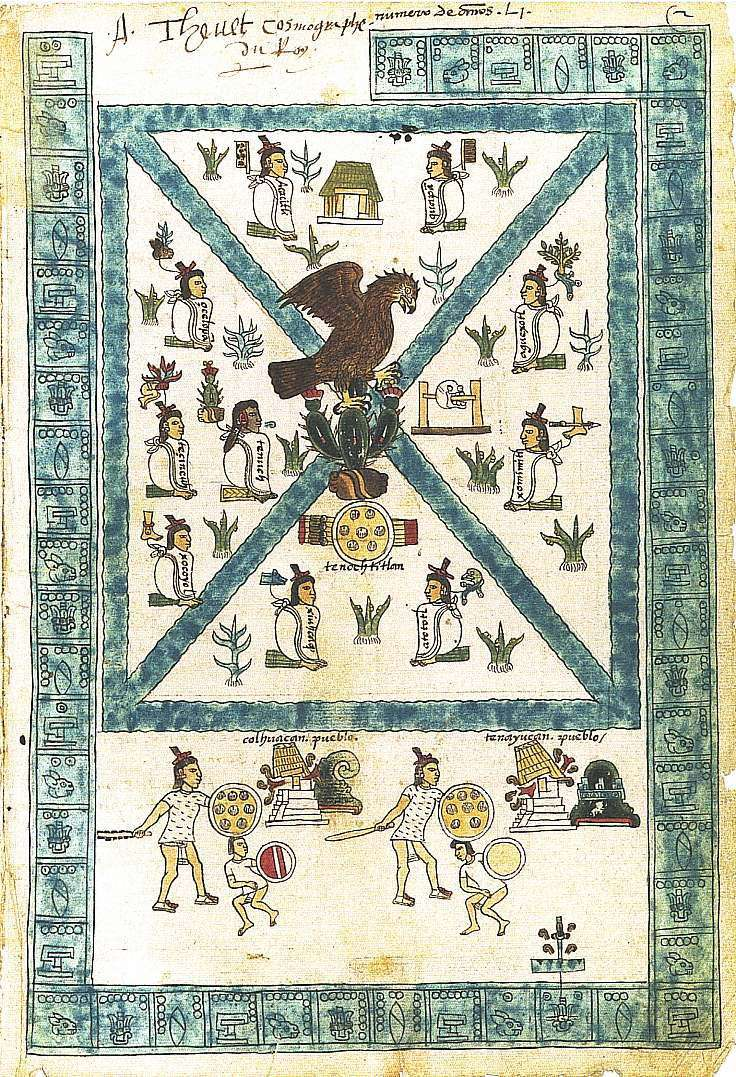
The Founding of Tenochtitlan Description


The Founding of Tenochtitlan is an Aztec-Spanish style painting of the Aztec city of Tenochtitlan, Mexico. This painting involves many elements. For example, the lines are simple and the thickness seems the same in all the lines in the painting. There are many shapes and forms that make up this painting, there are some that stand out the most. The shapes that are most obvious are rectangles, squares and triangles. The colors in the painting vary, the most outstanding color is blue. The painting is painted from a two dimensional view. The canvas looks like it is aging and it appears to be that way from the coloring and the space in the background.


In the painting, many of the images appear repetitive, some look mirrored. The painting details on the eagle are more complex than the details on the humans. The painting itself does not have much shading, if any at all. There is very little negative space as well. This painting is simple and shares a history of the city of Tenochtitlan, Mexico.