Wednesday, November 7, 2018

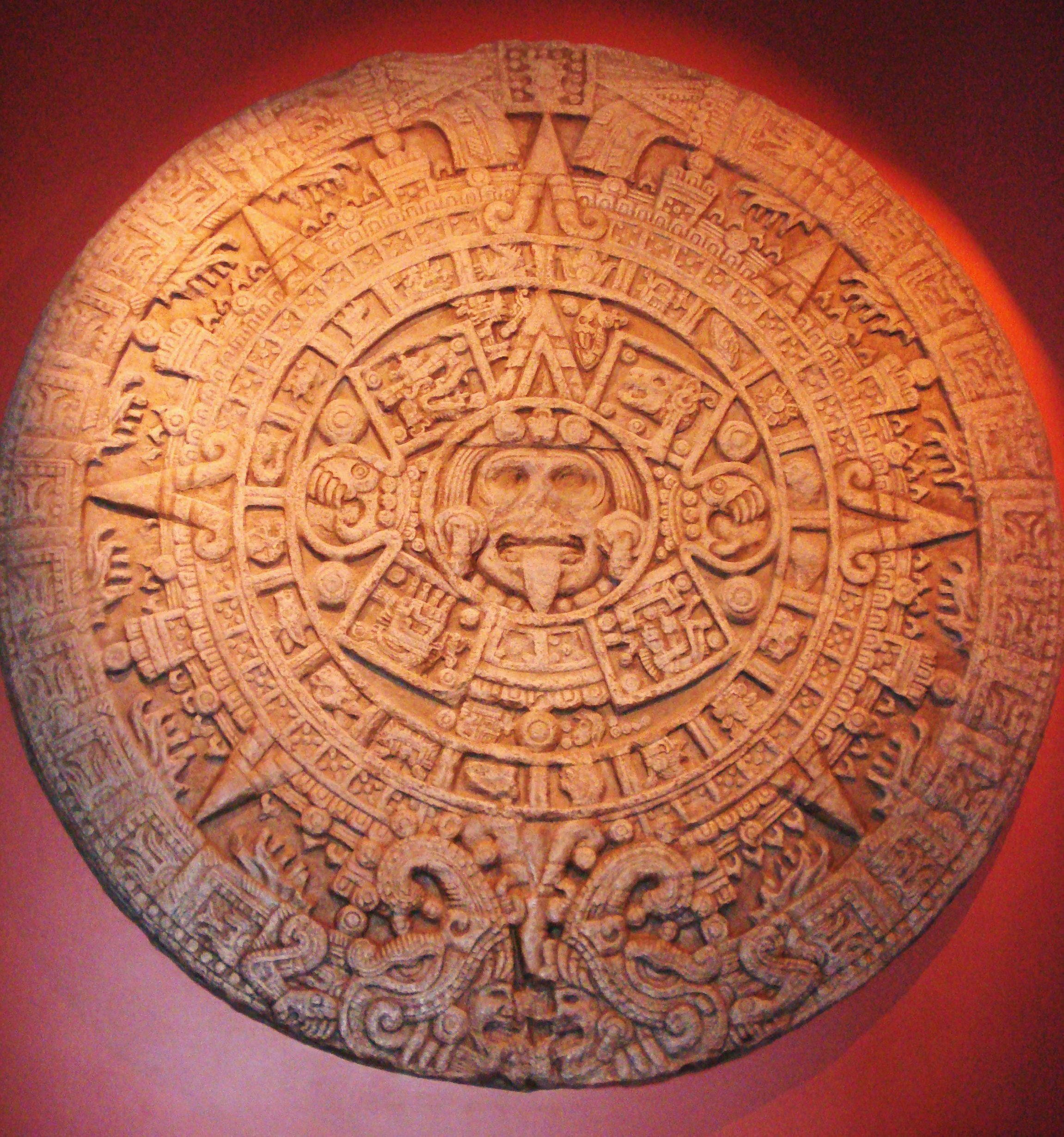
Stone of Five Suns

Stone of Five Suns
File:Aztec Sun stone depicting their concept of the universe.JPG

In this piece, it looks as it was carved from stone. The overall piece kind of looks as if it could be used as compass. The face in the center looks as if it could represent something important. The carvings of the piece are extremely detailed. It's like each carving in the piece has some sort of meaning behind it.

This piece was created at Teotihuacan. The story behind this piece involves two gods sacrificing their bodies to create new material for the world. One god arose to the Pyramid of the Sun, while the other God arose to the Pyramid of the moon. Then they both went in  bonfire. In the end they both became the sun and the moon. To repay the Gods, humankind had to provide human sacrifices in order to keep the fifth sun. Not only is this piece called the Stone of Five Suns. It's also called the Aztec Calendar Stone. The piece is made from stone, hence it is in the name of the work. There is really no actual author named for this piece, but it was created by the Azetcs.

Tuesday, November 6, 2018

The Two Fridas Description


The Two Fridas by Frida Kahlo (1939)
In one of her most popular and well-known works, Frida Kahlo's 1939 painting, The Two Fridas, was created as a  result of the emotionally and physically painful aftermath of her and Diego Rivera's bitter and messy divorce.

The double self-portrait carries heavy symbolism that references not only Rivera, but other aspects of Kahlo's life as well. As a duel-heritage citizen, prior to their marriage, Khalo dressed in European attire, however due to Rivera's passionate nationalism, Kahlo dressed in more traditional Mexican clothing to appeal to her husband's liking better. The two styles are portrayed as the 'two Fridas.' She had always felt that the Frida on the right was the one that Rivera loved, hence the picture of him in the locket in that figure's hand. The heart of the figure is also whole while the figure on the left is damaged and 'broken' because of Rivera's love for that version and the connection between his love versus the disconnection between his love and the version on the left. The scissors in the hand of the left Frida also symbolize the severing of the ties between her and Rivera.

Kahlo and Rivera's relationship are not the only represented in the massive oil painting however. The blood on the white dress is a reference to her fertility. 17 years prior to her creation of The Two Fridas, she was in a bus accident that left her with severe injuries. Over the years, Kahlo underwent many surgeries and suffered chronic pain. The injuries are also believed to have been the cause of several miscarriages throughout Kahlo's life, symbolized by the blood's location in the painting.

Overall, the composition generates a rather sad and tragic scene in which Kahlo was forced to endure every day for the rest of her life.


Gateway of the Sun Description

Picture by Mhwater
     This gateway in Taihuanaco, Bolivia depicts a smoothly carved stone gateway with low and high relief carvings at the top of the arch. Upon closer inspection one will see that the main figure in the middle is larger then the others and also appears to have a more ornate headdress than the other figures. The size difference in the figures most likely is meant to show that the larger figure is a one of power and might even be a depiction of a god. The smaller figures are depicted as having their own ornate headdresses and what may be tails or cloaks, this may point to the gateway being part of an old temple where ceremonies were held. The fact that the bottom part of the gateway is smooth may have to do with the wear of time or it may have been kept smooth on purpose in order to draw more attention to the carvings at the top of the arch.

     The large figure at the top is a depiction of the sun-god and may actually be the God Viracocha, whom was said to have created all things, but researchers lack enough evidence to prove this. The figure is one of ceremony as it is holding ceremonial staffs with feline and condor heads on either end of the them. The smaller figures are meant to be his close servants and it is unclear if they are human or not. Due to lack of evidence surrounding this gateway there have been many theories about what its' meaning is and why is was built. Some historians believe it to have been built as a gateway to another realm while others theorize that it was made to be a calendar.

Citations:
Smithfield, Brad. "The Gate of the Sun: A megalithic solid stone structure, confusing experts ever since its discovery." 19 April 2017. The Vintage News. 1 November 2018. <https://www.thevintagenews.com/2017/04/19/the-gate-of-the-sun-a-megalithic-solid-stone-structure-confusing-experts-ever-since-its-discovery/>.    

O'Riley, Michael Kampen. "Western Polynesia: Tonga and Samoa." O'Riley, Michael Kampen. Art Beyond the West. Ashville: Pearson Prentice Hall, n.d. 278.

Raimondi Stela Description

Raimondi Stela, Chavin de Huantar c. 460-300 BCE
This is a drawing of the Raimondi Stela that was originally drawn by Antonio Raimondi. This drawing depicts the Staff God of the Chavin de Huantar (900-200 BCE) as shown through the figure holding the two ornate staffs. There is a lot of line work and ninety degree intersections. most of the lines are fairly straight with occasional curvature that serves to create more detail for the figure. The god is shown with four heads with three stacked on top of the central head about one-third of the way up from the bottom. Their is sharp and precise symmetry between the left and right sides of the image and this balance of symmetry was a key component in Chavin art.

This piece shows several of the characteristics of Chavin art including the perpendicular intersections, simple lines repeated upon themselves to create a complex image, and symmetry. The piece also shows the technique of Chavin artists of using other animalistic ideas for body parts. The god is depicted with other heads for hair and with the heads sprouting serpentine appendages. This image creates a sort of illusion with the heads that was part of Chavin ceremonies that would be conducted with hallucinogenic snuffs. As a piece in total, it depicts the Chavin connection to abstraction and complexity.

Resources:
Fig. 1. Raimondi Stela, The Staff God. 2012, drawing, 6'5"*2'5". Wikimedia Commons,https://commons.wikimedia.org/wiki/File:Raimondi_Stela_(Chavin_de_Huantar).svg
(accessed November 6, 2018).

Monday, October 8, 2018


A Section of the Dresden Codex

The Dresden Codex, made of bark paper and fine stucco

A viewer cannot be helped but to be drawn to this piece as it immediately pulls one in with a sense of familiarity. If someone has never seen this piece before, they may find themselves pondering over the question of why as they become enamored with its unique combination of beautiful and distinct lines and use of color as an accent. After looking for awhile it may click, that the feeling of familiarity was stemming from common artwork in today's society: comics and storytelling. From the clear use of registers and implied boxes, this section of the Dresden Codex seems to tell a story through images and animation, which ultimately leads to the desire to learn the story it portrays.

The Codex is not just a story, but an entire book from pre-Columbia Mayan times, dating back to the 13th or 14th century, the oldest known book from the Americas. Believed to have been written by eight different people, the Codex is one of only four Mayan books still in existence.

Made up of 39 leaves, the Dresden Codex contains calendars, astrological phases, ceremonies, and much more, all in images, numbers and hieroglyphics.

Currently in the Saxon State and University Library in Dresden, Germany, the Codex is believed to be a copy from another book produced 300-400 years prior to its creation.


Source: https://www.wdl.org/en/item/11621/

Queen Mother Pendant Mask (Nigeria)


Before Research:
This piece provides a striking first impression with symmetrical features and an interesting mixture of textures. There are delicate veins running through the piece because of the material used, ivory, and there is added texture for the hair and the designs circling the head, giving a sense of balance and unity. The face has an air of strength and power, the eyes are heavy and open and even though the face is oval and smooth the gaze is strong along with the nose and mouth. 

After Research:
This piece is an early 16th century pendant mask carved from ivory representing Iyoba Idia, mother of Oba Esigie, and it would have been worn on ceremonial occasions as well as a pendant on a belt as a memorial to Iyoba Idia after her death. It is one part of a pair of nearly identical works. Iron inlays for the pupil and rims of the eyes intensify the gaze of the piece. The top of the pendant is decorated with bearded heads of the Portuguese which is a symbol of the good trade and alliance with the Portuguese. There are mudfish symbols are alternating with the Portuguese faces which is a primary symbol of Benin kingship and they represent an ability to survive in water and on land.

Sources:

Clarke, Christa. "Queen Mother Pendant Mask (Iyoba) (Edo Peoples)." Khan Academy. Last modified 
2016. https://www.khanacademy.org/humanities/art-africa/west-africa/nigeria/a/ 
queen-mother-pendant-mask-iyoba-edo-peoples. 
"Queen Mother Pendant Mask: Iyoba." The Met. https://www.metmuseum.org/art/collection/search/318622.


Tattooed Marquesan warrior


Before Research

This piece is eye-catching because it is a representation of a tattooed individual, something uncommonly seen in art history classes. The piece portrays a Marquesan warrior in a contrapposto stance. In one hand, he is holding a bag, and in the other, he is holding what appears to be a scepter/staff that rests on his shoulder. From head to toe, the warrior is covered in intricate tattoos; in a way, the piece of art contains more art on the subject itself. Different sections of his tattoos are made of lines forming various geometric patterns. There seems to be a disconnect between his body and his head; his body is stocky and muscular, but his face is slender and angular. His face and facial hair appear more European than Polynesian.


After Research
While the textbook does not specifically discuss this piece, it does offer insight into the significance of tattoos in Polynesian culture. Tataus, as they are called, are based on the ancient art form of body painting. Tattoo artists, called tubuka, skillfully used the line work of the tattoos to compliment the contours of the human form. The various geometric patterns and imagery translate ideas, such as warfare and killing (O’Riley). This permanent form of body art lends credit to the warrior’s status in his society.


Reference
Kampen O’Riley, Michael. Art Beyond the West: The Arts of the Islamic World, India and Southeast Asia, China, Japan and Korea, the Pacific, Africa, and the Americas. 2nd ed. Upper Saddle River. Pearson, 2013.